 This summer, I had the amazing opportunity of working as a research assistant to Dr. Madeline Hackney at Emory University. Dr. Hackney has a BFA in Dance from New York University, Tisch School of the Arts, and a Ph.D. in Movement Science from Washington University in St. Louis. Her doctoral research deals with movement disorders and neurological disorders. Obviously, being a dance and neuroscience dual degree student, Dr. Hackney’s work was extremely intriguing to me!
Over the summer, I worked on Dr. Hackney’s DREAMS Study, a project that studies the effects of continued education on geriatric persons’ cognitive and motor functions. The project had one group of participants that attended weekly health education classes. Their cognitive and motor functions were tested before the classes, tested after the classes, and then eight weeks following that test. I worked on this project by entering in data from testings, scoring cognitive tests, editing lessons for the seniors, calling/interviewing participants, and administering tests to participants. I was able to administer the 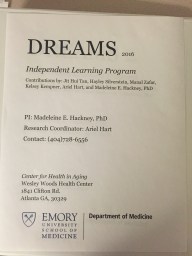 cognitive tests of the MOCA, London Tower, Stroop Test, spatial reasoning, Realm, and others. I also administered gait observation tests, walking tests, and other physical ability tests to seniors. I was able to administer these tests to multiple participants throughout the summer. I also interviewed the group of seniors on their studies weekly, recorded their responses, and talked with them about their ideas about the material.
In addition to DREAMS, I also worked on a continuation of Dr. Madeline Hackney’s Adapted Tango Study for Parkinson’s Patients in which she is testing the effects of leading versus following roles in Tango and their effect on cognitive and motor function (http://www.ncbi.nlm.nih.gov/pubmed/24116748). For this study, I was again was tasked with administering cognitive and motor tests, tests that were often very similar to the ones administered for DREAMS, if not the same exact tests. I also was tasked with helping administer functional MRIs to the participants. For the MRIs on the Parkinson’s patients, I set up technological devices (a foot tapper recorder, sound programs, etc.) as well as acted as the “tapper” for the testing. As a tapper, I tapped metered beats on the participants hand while the MRI test was being taken. The participant was instructed to tap on the foot tapper when they felt me tap on their hand. Thus, the meticulous nature of my job was important to keeping the experimental variables controlled.
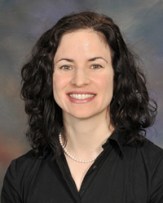
I was very grateful that Dr. Hackney allowed me to have this amazing experience working for her, and I hope to continue working for her throughout my undergraduate studies. Dr. Hackney’s research perfectly combines my interests in neuroscience and dance as she is a pioneer in using dance to solve neurological disorders. I found a love for research through this opportunity, and I hope to make my own discoveries between the brain and the body in the future. I also discovered a love for working with people throughout the summer. Above all, I am even more certain that it is possible to be both a successful professional dancer as well as a cutting edge scientist. Thus, I plan to have both of those careers in my future. I think the marriage of science and dance can and will have monumental effects on the course of research.
 Kelsey Kempner